By Dr. Monika M. Doss, DBA – Progressive Work Institute Founder, Executive Director
Organizational behavior scholar-practitioner with an emphasis on work design that reduces burnout, improves worker well-being, and optimizes organizational performance through Progressive Work.
The worker burnout crisis continues to plague individuals and organizations globally. Decades of research have illuminated its dire consequences: declining mental and physical health, reduced productivity, disengagement, and skyrocketing turnover rates. Despite this, the traditional 9-to-5 work structure, birthed during the Industrial Revolution, remains the cornerstone of most organizations. This antiquated model prioritizes rigid schedules and profit over worker well-being, fostering the toxic conditions that fuel burnout.
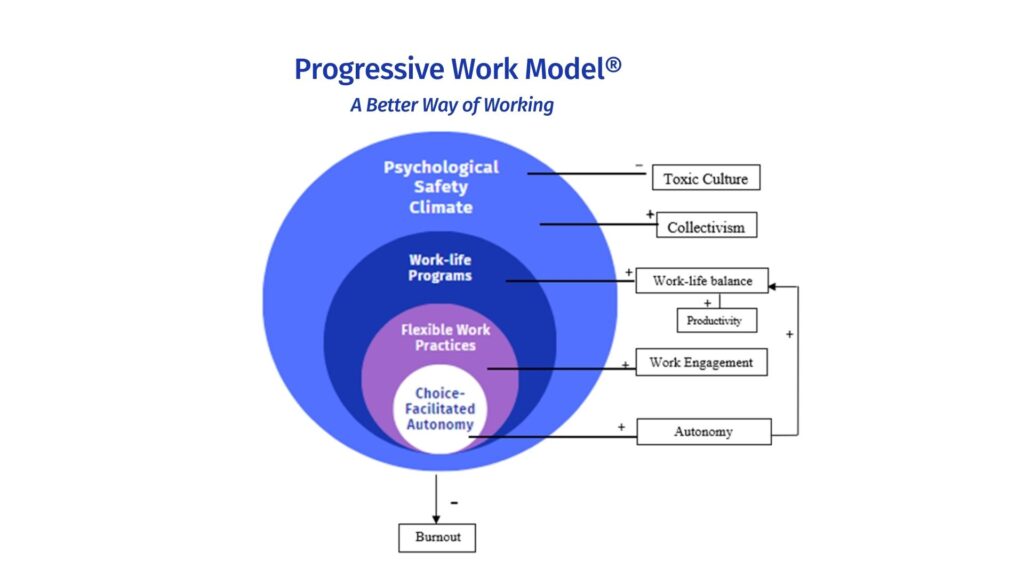
It is time for a transformative shift. The Progressive Work Model (PWM), an empirically tested framework I empirically designed, integrates choice-facilitated autonomy, flexible work practices, and work-life programs within a psychologically safe climate. The PWM reimagines work design in alignment with modern workforce needs, offering a sustainable solution to mitigate burnout while enhancing organizational performance.
Burnout: A Global Epidemic
Defined as a psychological syndrome stemming from prolonged workplace stress, burnout manifests as exhaustion, cynicism, and reduced efficacy. The World Health Organization (WHO) recognized burnout as an occupational syndrome in 2019, emphasizing its systemic roots in organizational structures. Alarmingly, studies reveal that 61% of workers report frequent burnout, contributing to a $322 billion annual loss in turnover and productivity globally.
Traditional work structures exacerbate these issues. The rigidity of the 40-hour, location-dependent workweek fails to accommodate the complexities of modern life, leaving workers feeling powerless and undervalued. Even flexible work practices, when implemented piecemeal, often fall short of addressing the systemic issues at play.
The Progressive Work Model: A Holistic Solution
The PWM offers a comprehensive, forward-thinking approach that coalesces elements proven to combat burnout:
- Choice-Facilitated Autonomy:
Autonomy is a cornerstone of engagement and a potent antidote to burnout. The PWM introduces choice-facilitated autonomy, allowing workers to select their job status when accepting a job —whether as an employee or independent contractor. This empowers individuals to tailor their work arrangements to align with personal and professional goals, mitigating lack of control over their work and life domains. - Flexible Work Practices:
Flexibility is no longer a luxury but a necessity. The PWM incorporates diverse options such as hybrid work, flextime, and compressed workweeks. These practices enable workers to navigate personal responsibilities without sacrificing productivity, fostering a healthier work-life balance. - Work-Life Programs:
Effective work-life programs support health and well-being, addressing the human need for balance. From mental health resources to parental leave, these programs underscore an organization’s commitment to its workforce, promoting loyalty and engagement. - Psychological Safety:
A positive psychological safety climate is essential for reducing burnout. It ensures that workers feel valued, respected, and safe to voice concerns without fear of retribution. Organizations that prioritize psychological safety report higher engagement and lower turnover rates, validating its critical role in sustainable work design.
Empirical Evidence for Change
The PWM is not a theoretical exercise but an empirically tested framework. In a global study involving over 8,400 workers across 81 countries, & six continents my research found that organizations adopting PWM components experienced significant reductions in burnout. Improving worker well-being, enhanced productivity, and greater alignment between their work and life domains.
Moreover, the PWM aligns with broader cultural and generational shifts. Millennials and Gen Z, who now comprise the majority of the workforce, demand flexibility and autonomy. A Deloitte survey found that 80% of respondents would decline a job lacking flexibility, underscoring the urgent need for progressive work design.
Why Organizations Must Act
The cost of inaction is high. Burnout drives turnover, disrupts operations, and erodes organizational climate. Yet, the benefits of adopting the PWM extend beyond mitigating these risks. Organizations that prioritize worker well-being attract and retain top talent, enhance their reputations, and achieve long-term sustainability.
The recent wave of labor activism—strikes, unionization, and legislative reforms—reflects a collective demand for change. From the 32-Hour Workweek Act to the Workforce Psychological Safety Act, there is growing momentum to rethink work. Organizations that embrace the PWM can lead this transformation, setting a new standard for sustainable work design.
A Call to Action
Burnout is not an inevitability; it is a systemic failure that demands systemic solutions. The Progressive Work Model offers a path forward, challenging organizations to prioritize worker well-being without compromising performance.
This shift requires courage and commitment. It demands that organizations move beyond entrenched practices and embrace a future where work is designed for humans, not machines. But the rewards—healthier, happier workers and thriving organizations—are worth the effort.
As a scholar-practitioner, I invite leaders, policymakers, and researchers to join this movement. Together, we can dismantle the structures that perpetuate burnout and build a future where work empowers rather than exhausts. Let us seize this moment to redefine work for the better.
Concluding Thoughts
The Progressive Work Model is more than a framework; it is a call for humanity in the workplace. It reminds us that progress is not about defending the past but advancing the future. By adopting the PWM, we can create a world where work fosters well-being, engagement, and purpose—a world where burnout becomes a relic of the past.
Let us lead the charge toward progressive work. The time for change is now. Signup for our free pilot program today