By Dr. Monika M. Doss, DBA – Progressive Work Institute Founder, Executive Director
Organizational behavior scholar-practitioner with an emphasis on work design that reduces burnout, improves worker well-being, and optimizes organizational performance through Progressive Work.
Worker burnout has reached epidemic proportions. Even before the pandemic, it plagued millions, exacerbating mental health crises and costing billions in lost productivity. Despite this, traditional work structures persist, rigidly defining schedules and locations with minimal worker input. In contrast, flexible work practices introduced incremental improvements but failed to fully address burnout’s systemic roots. What if there were a more comprehensive solution?
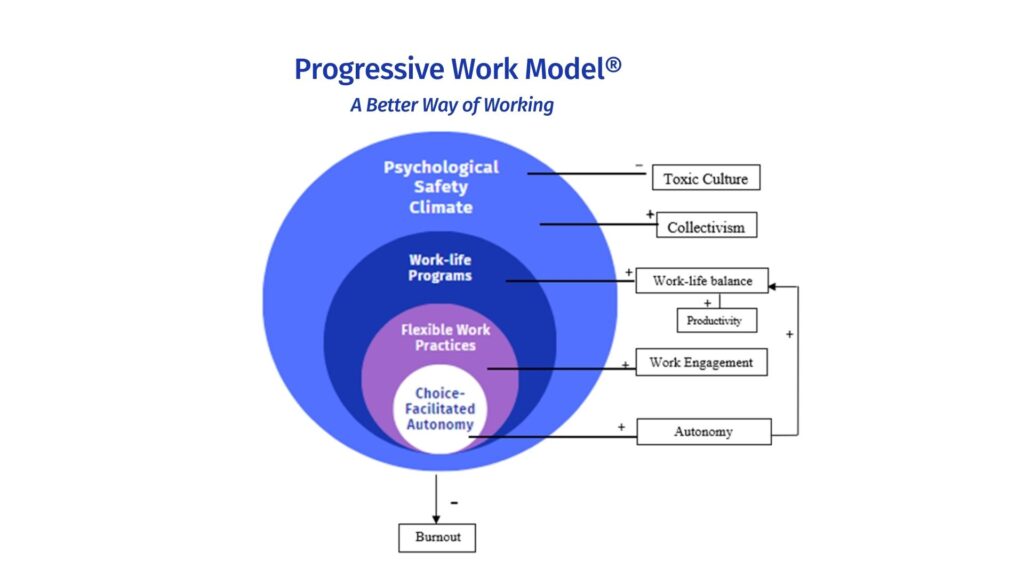
Enter the Progressive Work Model (PWM), an empirically designed framework developed to address modern work-life needs. Grounded in autonomy, flexibility, work-life balance, and psychological safety, this model reimagines how work is designed, offering solutions to mitigate burnout while enhancing worker engagement and improving organizational performance.
The Problem with Traditional Work
The traditional 9-to-5 emerged in the Industrial Revolution, an era where factory shifts demanded predictability. While this model served its purpose then, it is increasingly ill-suited to the complexities of today’s workforce, particularly in a technologically driven global economy.
Rigid schedules often conflict with personal responsibilities, limiting workers’ autonomy and contributing to burnout. Studies reveal that chronic stressors like inflexible work arrangements not only decrease productivity but also lead to mental and physical health issues, including sleep disorders and cardiovascular problems.
Moreover, traditional work culture perpetuates disengagement. Workers often feel like cogs in a machine, valued only for their output rather than their humanity. This erosion of purpose and autonomy intensifies burnout, disengagement, and turnover, as evidenced by the ongoing Great Resignation.
The Promise of Autonomy
Autonomy lies at the heart of the PWM. It involves granting workers control over how, when, and where they work, fostering a sense of ownership and purpose. Research consistently shows that autonomy reduces burnout and enhances engagement.
Take choice-facilitated autonomy, a key pillar of the PWM. This concept empowers workers to choose their job status when accepting a job rather than the organization pre-determining it —whether as an employee or independent contractor—thereby aligning their roles with their personal and professional goals. By shifting decision-making power from organizations to individuals, this approach counters feelings of powerlessness and promotes agency.
Flexible Work Practices: Beyond a Temporary Fix
Flexible work practices, while widely adopted post-COVID-19, often remain piecemeal solutions. They include remote work, flextime, and hybrid models, which provide some relief from rigid structures but fail to comprehensively address burnout.
The PWM integrates these practices into a cohesive framework, ensuring that flexibility is not just a perk but a foundational principle. For instance, hybrid models combine the benefits of on-site collaboration with the freedom of remote work, reducing commuting stress and fostering work-life balance. Similarly, flextime accommodates personal schedules without sacrificing productivity.
Empirical evidence supports these interventions. Organizations adopting four-day workweeks have reported increased productivity and decreased burnout. When Microsoft Japan trialed this model, productivity soared by 40%, and Iceland’s government found similar success with improved well-being and no loss in output.
Psychological Safety: The Missing Piece
While flexibility and autonomy are crucial, they cannot thrive without psychological safety climate. Defined as an environment where workers feel secure to express ideas and take risks without fear of reprisal, psychological safety is essential for fostering trust and collaboration.
Unfortunately, only 26% of managers create such environments, despite 89% of workers identifying it as critical. The PWM prioritizes psychological safety by integrating it into organizational culture, aligning policies and practices to support mental health and well-being.
Research highlights its importance: workplaces with high psychological safety report lower burnout rates and higher engagement levels. For example, healthcare organizations that prioritize safety and active listening have seen marked improvements in worker resilience and satisfaction.
Global Implications
The PWM’s emphasis on autonomy and flexibility makes it adaptable across cultural contexts. For example, in collectivist cultures, where community and interdependence are highly valued, choice-facilitated autonomy can align work roles with familial responsibilities, enhancing both worker satisfaction and societal harmony.
Conversely, in individualist regions, such as Oceania, the PWM prioritizes personal agency resonating deeply, enabling workers to tailor their schedules and workloads to their unique preferences. While co-existing with collectivism when performing work.
A Call to Action
The time to act is now. The pandemic has exposed the fragility of traditional work structures, offering a rare opportunity to rebuild. Progressive work is not just a luxury but a necessity, as evidenced by the rise in strikes, resignations, and demands for better work conditions worldwide.
Organizations must embrace change, not just to retain talent but to thrive in an increasingly competitive and globalized world. By adopting the PWM, organizations can create environments where workers are not only productive but also engaged and fulfilled.
Concluding Thoughts
Autonomy is more than a principle; it is a catalyst for change. By empowering workers, embracing flexibility, and fostering psychological safety, the Progressive Work Model offers a path forward—one that mitigates burnout, enhances engagement, and redefines success in the workplace.
For scholars, practitioners, and leaders, the message is clear: the future of work demands progress. Let us abandon outdated norms and champion work design that values the well-being of workers as much as organizational performance. Together, we can build a better way of working—a truly progressive way.
Be part of the solution. Signup for our free pilot program today.