By Dr. Monika M. Doss, DBA – Progressive Work Institute Founder, Executive Director
Organizational behavior scholar-practitioner with an emphasis on work design that reduces burnout, improves worker well-being, and optimizes organizational performance through Progressive Work.
COVID-19 unpredictability has many workers across the globe rethinking the way they work. However, as the problem of burnout persists, the way we work is a main cause of the problem. The antidote is that we must change how we work (Maslach, 2001).
As workers moved through different stages of the pandemic, each month presented new difficulties – from traumatic lockdowns and sheltering in place to abrupt changes in how and where we work. The instability left many workers fed up with the status quo because they experienced working a different way while still being productive. Demanding more flexibility, the unprecedented phenomenon dubbed the Great Resignation showed that the workforce is reclaiming its power by no longer kowtowing to an antiquated way of working, primarily driven by the 9-to-5 work model – a work model that was birthed in the Industrial Age to accommodate machine run times. Well, people are not machines. We are human. We constantly ebb and flow between work and life domains requiring flexibility.
Workers across the globe are demanding a better way of working. As we see record-breaking union formations and strikes making headlines (bus drivers in Japan, CVS/Walgreens pharmacists; Garment workers in Bangladesh – for H&M, Levi’s, Gap, and Zara; Kaiser-Permanente workers – largest healthcare strike in U.S. history; Tesla workers in Sweden; United Auto Workers; UPS drivers; and Writer’s Guild of America), and workers in France protesting pension changes. Also, F500 CEOs were held accountable for union busting, the 32-hour, 4-day workweek was introduced at the national and state level in the U.S. in 2023, and a Workplace Psychological Safety Act bill was introduced in 2023 because toxicity is such a prevalent issue (S 821A, 2023).
What is Worker Burnout?
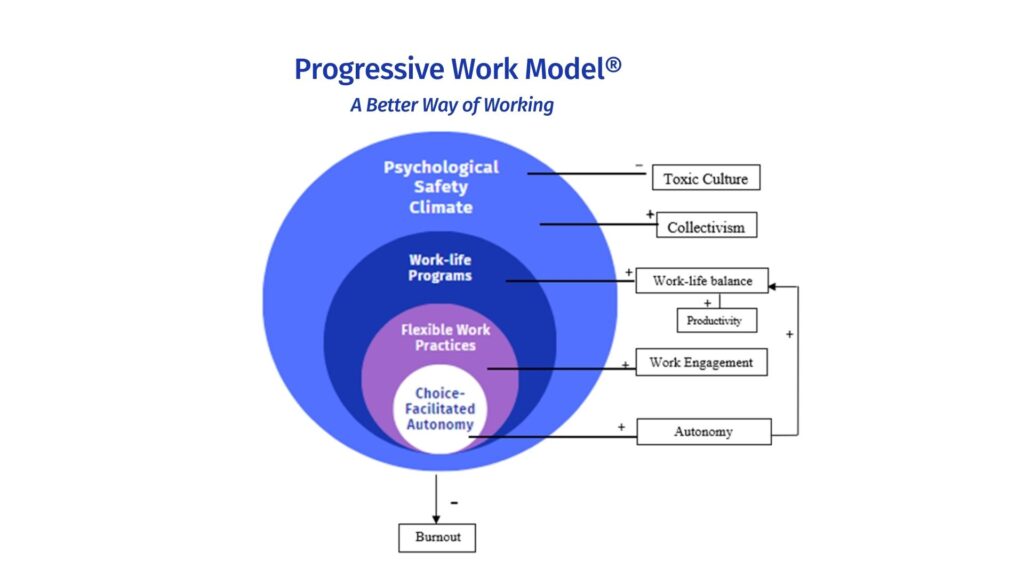
Worker burnout results from unmanageable workloads, pay gaps, and toxic workplaces, exacerbated during COVID-19, leading to reduced productivity and work-life balance. Shifting to the Progressive Work Model (PWM) aligns with individual work-life balance needs to combat this issue. This model includes a psychological safety climate, job status choice, flexible work practices, and work-life programs. Despite ongoing risks, workers have been ordered to return to the workplace, exacerbating the prevalence of burnout (Doss, 2024).
Craving progressiveness in unprecedented times
Workers feel anxious, exhausted, and overburdened. The Great Resignation proves that workers desire a progressive approach to work and are flocking to companies that offer flexibility. Yet, organizations worldwide remain fixated on controlling their employees. Even though 80% of workers seek a flexible work schedule, 74% of companies dictate their workforce’s hours, and 64% emphasize that they will continue the outdated 9-to-5 model despite evidence showing its adverse effects (AT&T, 2022).
What is the solution?
Progressive work reduces worker burnout. So, the proposed solution to the persistent problem of burnout is the Progressive Work Model (PWM) because the components address the predictors of burnout, which are pay gaps, toxic cultures, and unreasonable workloads (Doss & Feyerherm, 2024). The focus is creating a solution to the problem of burnout that can be implemented into practice to help recoup the $322 billion lost to turnover and reduced productivity, of which burnout accounts for 15-20% (Gallup, 2021).
Progressive Work Model™
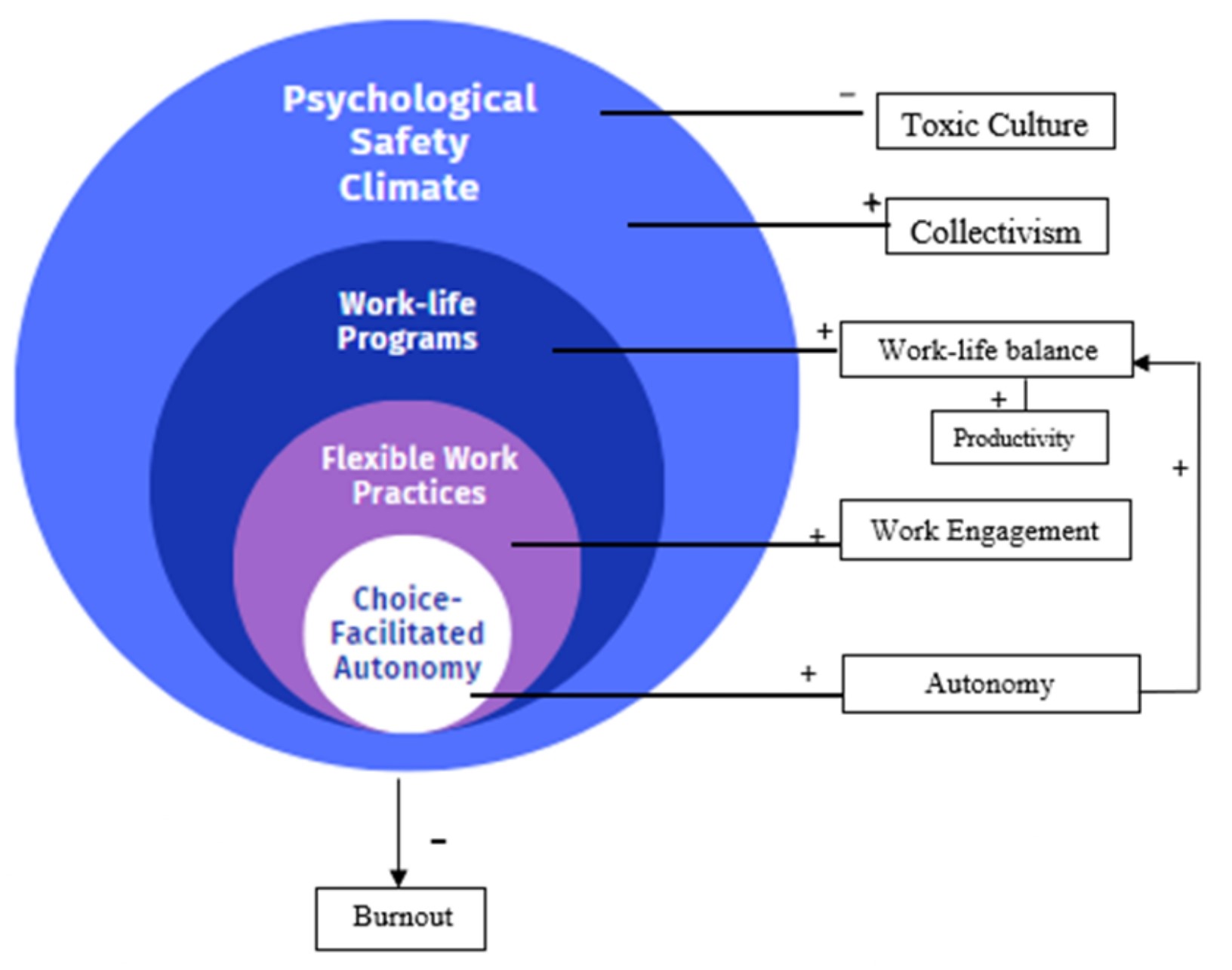
Some suggestions that individual contributors, managers, and executive/C-suite can consider implementing to shift towards the PWM and combat burnout:
Individual Contributors
You have the power to go where your work needs are being met. This is, in part, what the Great Resignation is about. You do not have to stay where your work-life balance is not prioritized. Look for organizations that prioritize work-life balance. When searching for new job opportunities, look for companies that offer elements of progressive work. Do your research on company culture – read reviews from current and former workers to get a sense of what it is like to work there. For example, Dropbox uses a hybrid model – 90% remote and 10% in-office for essential meetings. The CEO made headlines during the back-to-office debate, stating that workers are not resources to control. Implying that this organization prioritizes autonomy. In addition,
Also, talk with your manager about your work-life balance needs and how the PWM could benefit you and the company. If your company already offers flexible work, take advantage of them. In addition, prioritize self-care – set boundaries for yourself and prioritize your mental and physical health. For example, take breaks throughout the day and disconnect from work when you are off the clock. Prioritizing self-care can help prevent burnout and improve work-life balance. Furthermore, explore alternative work arrangements – consider alternative work arrangements like freelancing if your current job does not offer the necessary flexibility. For example, many platforms specialize in connecting workers with flexible job opportunities. Finally, when searching for new job opportunities, look for companies that prioritize work-life balance by looking for organizations that offer progressive work.
Managers
How you treat your team members is the most important driver of how they experience their jobs. Remember, workers do not quit jobs. They quit managers. Create a psychologically safe environment so your team feels comfortable making requests such as raises, asking for a promotion, and using PTO – currently, only 26% of managers do this (McKinsey & Company, 2021). PTO is part of work-life programs and has to be used to mitigate burnout (Doss, 2024).
Executives/C-suite
Right now, you can make an executive decision to give Human Resources (H.R.) the authority to implement the PWM via a progressive work policy to reduce burnout and help recover the billions lost to turnover. H.R. is probably one of the most underutilized departments, and they are usually limited to operating within the status quo of protecting the company. How about expanding the role of H.R. to prioritize the worker, too? H.R. is the nucleus of an organization because it has a reach to all levels and the expertise to tailor progressive work to meet the needs of each department while still abiding by current labor laws.
There is a reason why the Chief People Officer is a relatively new addition to the C-suite. The workforce is a valuable asset. So let H.R. allow applicants to decide their job status instead of H.R. and management pre-determining it, work with managers to implement flexible work practices that work for each respective department, and review your current work-life programs to recommend ways to optimize them to meet your workforce’s current needs.
Imagine if every worker did just one of these suggestions, how burnout and toxic cultures would become the exception instead of the norm. Those recouped costs could be redirected to raising wages or investing in work-life programs.
As a collective, we can help make work a consistent positive experience. Overall, workers have the power to take action to shift toward the Progressive Work Model by prioritizing their mental and physical health, advocating for change, and seeking out companies that prioritize work-life balance. These steps could eventually make the antiquated 9-to-5 obsolete, as companies that do not adapt to the overwhelming demand of flexible work will have difficulty recruiting talent.
The power lies with the workforce. The global workforce is the nucleus of the world’s economy. By taking these steps, the workplace can become a consistent positive experience.
Be part of the solution. Signup for our free pilot program today.