By Dr. Monika M. Doss, DBA – Progressive Work Institute Founder, Executive Director
Organizational behavior scholar-practitioner with an emphasis on work design that reduces burnout, improves worker well-being, and optimizes organizational performance through Progressive Work.
In the fast-paced landscape of today’s professional world, burnout has become an increasingly prevalent issue, adversely affecting workers and organizations. In the ever-evolving landscape of changing the way we work, the problem of burnout demands a progressive organizational zen blueprint for burnout prevention . To address this challenge head-on, it is imperative to modify organizational structures, systems, and workspaces strategically. While the role of managers is pivotal in this transformation, a comprehensive approach involves redefining productivity metrics, reducing workplace noise, fostering collaboration, and designing jobs for autonomy. From minimizing interruptions to championing autonomy, I explore a comprehensive way of working that is resilient, innovative, and in tune with the needs of the modern workforce.
Modify Organizational Structures, Systems, and Workspaces to Prevent Worker Burnout
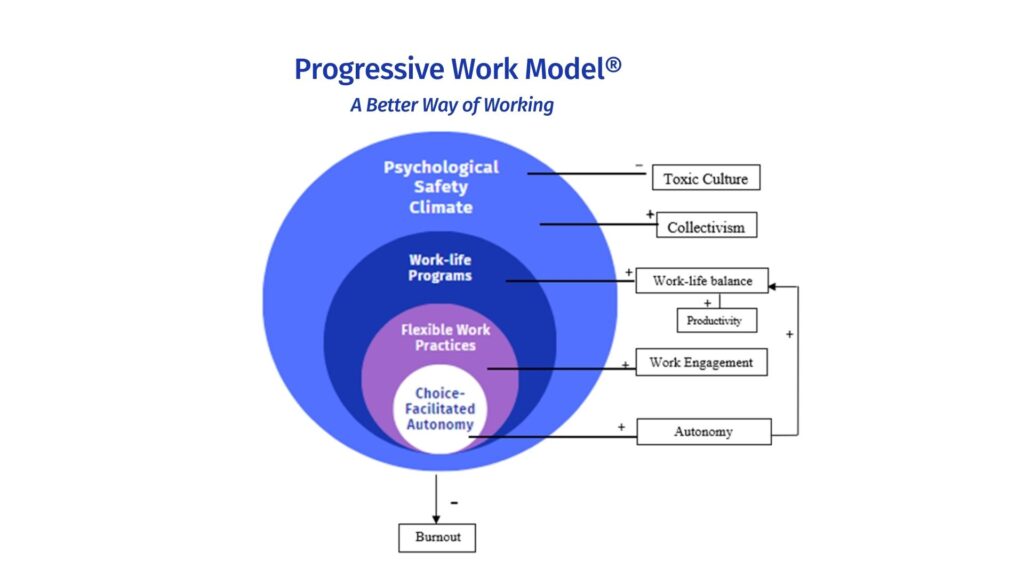
Enter the forward-thinking framework of progressive work. A dynamic approach designed to organize work activities and processes with precision. Rooted in the ethos of work-life balance, progressive work reshapes managerial roles, redefines productivity metrics, and reimagines the very fabric of collaboration. Actionable strategies to prevent burnout, enhance well-being, and create a resilient work environment.
Organizations should strongly emphasize manager development when setting priorities for burnout-related strategies. Research consistently demonstrates that a direct manager has the most significant impact on worker burnout. However, workers’ risk of burnout is also affected by issues related to their work environment, the demands placed on them, and the structures and systems in which they work. Managers’ responsibilities include positive worker experiences and learning to alleviate workplace stress. For example, mandating last-minute overtime instead of making it optional, and asking for additional duties outside the job description without additional compensation.
Managers’ responsibilities are setting clear expectations, removing obstacles, facilitating collaboration, and ensuring that workers are fully supported in doing their best work. Managers can proactively stop burnout before it starts by modifying inefficient processes. For example, meetings have tripled since 2020, and almost a third of meetings are unnecessary and could have been an email – wasting $25m per year (Laker et al., 2022). In the end, managers significantly impact how workers feel about their jobs. To modify organizational structures, systems, and workspace to prevent burnout, organizations should place productivity expectations and metrics within workers’ control, reduce noise and interruptions, provide inviting collaboration spaces, and design jobs to allow for autonomy.
Place Productivity Expectations and Metrics Within Workers’ Control
Productivity is accomplishing the deliverables required to do the job. Productivity metrics tell workers and their managers how they are doing and should be based on the value brought to the role, not solely on the number of hours worked – especially for knowledge workers. There are five key ways to measure productivity that is equitable across roles: (1) 360-degree feedback – generated from co-workers based on their honest assessment of a worker’s overall contribution toward team goals, (2) time tracking/project management software, (3) profit generate – how much value (profit) a worker brings to the organization, (4) getting deliverables done – whether or not tasks are completed, (5) service with a smile – how many customers emails/calls handled, customer feedback. As a natural consequence, these productivity metrics shape performance discussions and determine incentive compensation. Workers who firmly believe they have command over their productivity metrics are 55% less prone to experiencing frequent burnout (Gallup, 2021).
Reduce Noise and Interruptions
When workers regularly experience interruptions, this leads to a decline in the quality of their work, negatively impacting their overall well-being. To reduce these burnout accelerators, organizations can create comfortable workspaces. Deliberate and well-planned efforts should be prioritized to design workspaces designated for optimal performance and minimal interruptions. The two workplace features workers want most are privacy and a personal workspace (Gallup, 2021).
Provide Collaboration Spaces That Are Inviting
Employees who are provided with a workspace that helps them interact with colleagues experience a reduction of 26% in the likelihood of frequently experiencing burnout (Gallup, 2021). When workers encounter situations such as waiting for conference rooms, being confined to private offices for group discussions, or dealing with distracting ambient noise, the collaborative process can become a source of stress. For example, Cisco has a department that helps organizations make workspaces inviting to make the commute worth their workforce’s time – grey cubicles with fluorescent lighting are not inviting. An effective collaborative space should incorporate ample room for movement, a whiteboard, the capacity for teleconferencing, and acoustic conditions that ensure everyone can communicate clearly.
Design Jobs to Allow for Autonomy
Job autonomy is the flexibility and authority to determine the methods of accomplishing tasks. It serves as a strong catalyst for achieving deliverables and can manifest in various ways, ranging from personal discretion in task selection and time allocation to the ability to choose work schedules and locations. Roles structured to foster autonomy achieve this by establishing well-defined outcome expectations and limitations. Additionally, granting workers a suitable degree of decision-making autonomy over their tasks and the approaches they adopt to complete their deliverables is empowering.
Prospective workers frequently list engaging tasks and opportunities for growth and skill development as primary motivations for wanting to work at an organization. They also seek roles that offer flexibility where they can exercise discretion regarding their work location and hours. More than half of workers express a willingness to transition to a job that offers flexible working hours. This is why flexibility significantly influences workers’ work-life balance to reduce their susceptibility to burnout. While providing autonomy is crucial, organizations must balance too little and too much.
Too much autonomy can lead to heightened uncertainty and strain collaborations, posing a potential for burnout. Even when workers have flexibility, it remains essential for managers to establish clear role expectations, maintain frequent communication, and collaborate with their team to define objectives. For instance, remote work can create ambiguous expectations and feelings of isolation if remote workers are mismanaged. Leaders and managers should work with HR to align the appropriate level of autonomy and flexibility when designing a job.
Using progressive work to prevent burnout could help recoup the $322b lost to turnover and reduced productivity, and continue meeting the needs of the modern workforce so we do not repeat history and get stuck in a way of working that does not evolve with the workforce.
Be the solution. Signup for our free pilot program today progressivework.org