By Dr. Monika M. Doss, DBA – Progressive Work Institute Founder, Executive Director
Organizational behavior scholar-practitioner with an emphasis on work design that reduces burnout, improves worker well-being, and optimizes organizational performance through Progressive Work.
The 9-to-5 is obsolete.
In the rapidly evolving realm of work, the conventional 9-to-5 routine is losing its allure globally. The demand for a more efficient and compassionate approach to work is rising as worker burnout, an enduring and widespread issue, has escalated to epidemic proportions worldwide. Commuting, rigid schedules, and the clash between professional and personal responsibilities have exacerbated this problem, necessitating a paradigm shift. It is increasingly evident that the 9-to-5 is no longer the norm but is transforming into the exception.
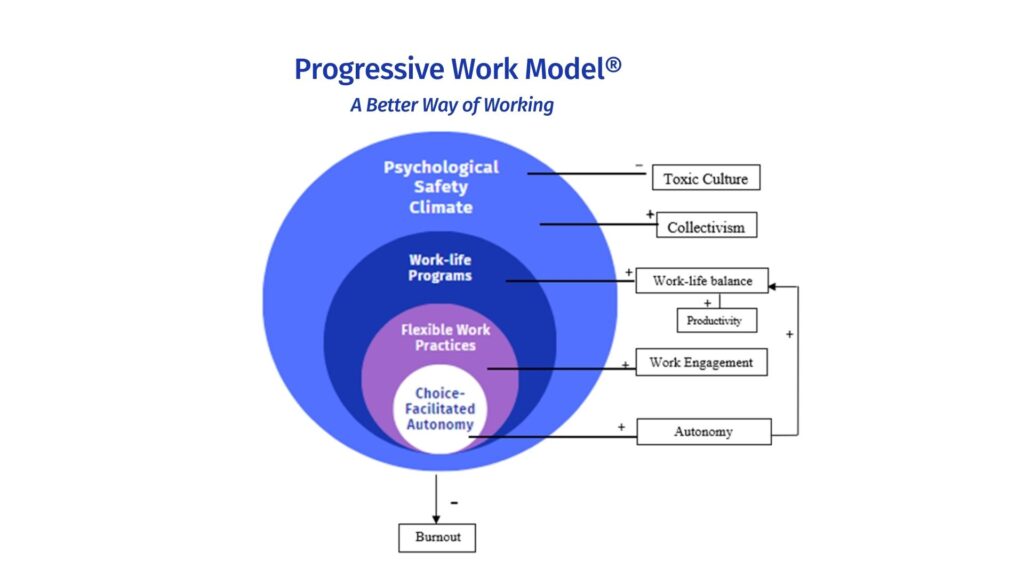
Recognizing this urgent need for change, I embarked on a comprehensive research journey to develop a transformative solution – the Progressive Work Model (PWM). This innovative framework strategically organizes work activities to align with the contemporary workforce’s demands for an enhanced work-life balance. The PWM addresses burnout by endowing workers with increased autonomy and flexibility, crucial components often absent in traditional work settings.
Recent seismic events, notably the Great Resignation of 2020, have marked a turning point in the power dynamics between workers and organizations. Unprecedented union formations and strikes across diverse industries globally underscore a collective demand for substantial change. Legislative measures like the Thirty-Two Hour Workweek Act in the U.S. and the Workforce Psychological Safety Act further underscore dissatisfaction with conventional work structures. The workforce is unmistakably calling for a more progressive approach to work.
Burnout, recognized as an epidemic even before the COVID-19 pandemic, has profound implications for individuals and organizations. The staggering costs, exceeding $100 billion in annual healthcare spending in the U.S. alone, underscore the urgency of addressing this pervasive issue. Burnout manifests as a multifaceted syndrome marked by exhaustion, cynicism, and a sense of ineffectiveness, often stemming from chronic workplace stressors and unmanageable workloads.
A 2021 Indeed study reported that 52% of respondents feel burned out, with 80% attributing workplace burnout to the impact of COVID-19. These statistics paint a grim picture of the widespread nature of burnout, affecting workers across different sectors and demographics. The Great Resignation trend persists, with over 4.3 million workers voluntarily leaving their jobs in February 2022, according to the U.S. Bureau of Labor Statistics.
In response to this pervasive issue, I propose a four-pronged approach within the PWM: psychological safety, choice-facilitated autonomy, flexible work practices, and work-life programs. Psychological safety helps ensure the workers’ perception of the workplace environment has minimal toxicity and is ideal for functional design components to thrive. Choice-facilitated autonomy empowers individuals to determine whether they prefer classification as employees or independent contractors, giving them greater control over their terms of employment while facilitating their desired level of autonomy when performing the job. Flexible work practices permit employees to dictate how, when, and where they work, effectively addressing unmanageable workloads. Concurrently, work-life programs that support health and work-life balance contribute to a more humane and balanced work environment.
Moreover, the study underscores the importance of psychological safety, a key factor inversely correlated with burnout. Despite 89% of workers deeming it essential, only 26% of managers create psychologically safe environments, highlighting a substantial gap between worker expectations and organizational offerings.
The central question, “Does a progressive organizational work model mitigate burnout?” presents a compelling case for reevaluating the traditional 9-to-5 paradigm. The PWM emerges as a comprehensive solution that addresses burnout and challenges and advances understanding by presenting a holistic model for organizations to adopt.
The significance of the PWM extends beyond its potential to transform organizational practices; it resonates personally. Burnout, affecting me, friends, family, and colleagues, underscores the urgency for change. The PWM stands as a beacon of progress, aligning work design with evolving expectations, autonomy, and support for personal lives. As the world moves forward, the 9-to-5 is becoming the exception, and embracing the PWM is not just a choice but a necessity for a healthier, more balanced future. Progress demands change, and the PWM offers a path toward a new era of work where burnout is mitigated, and workers thrive.
Be part of the solution. Signup for out free pilot program today.